Hedge laying and winter hedge cutting on the chalk
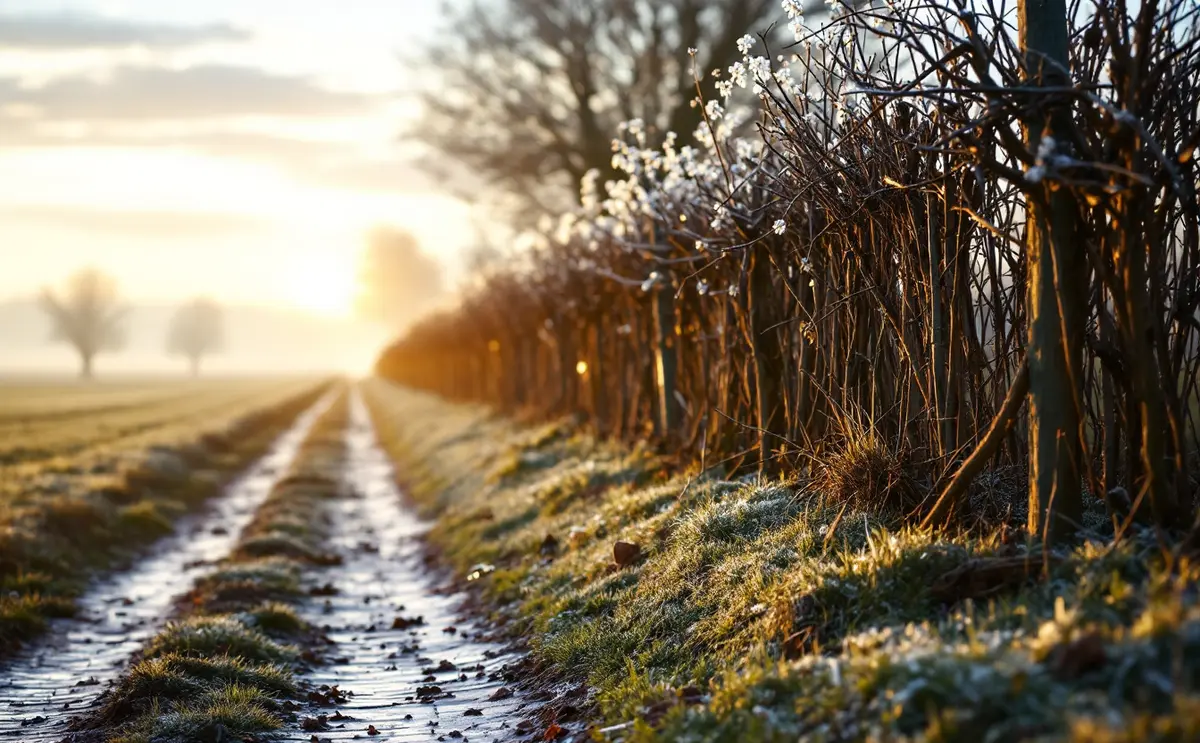
Late autumn is when the hedges change shape. Through spring and summer they grow shaggy and loud with birds; then, from September onwards, the tractors come along with their flails and the field boundaries round Offley and Lilley go back to neat green boxes. Every so often, on a cold morning, you find something quite different: a stretch of hedge cut almost to the ground, its stems bent over and woven between stakes, looking from a distance like a long, low basket. That is a laid hedge, and it is one of the oldest crafts in the countryside.
This piece covers both: why cutting happens when it does, how laying is done, and what each means for the wildlife that lives in a hedge.
Why the cutting waits until autumn
A hedge is a nursery from early spring to late summer. Blackbirds, song thrushes, dunnocks, wrens, chaffinches, linnets, yellowhammers and whitethroats all nest in or at the foot of farm hedges, some of them raising two or three broods. Cutting through that season destroys nests and leaves the survivors exposed.
In England, the rules for farm hedges are now set by the Management of Hedgerows (England) Regulations 2024, which came into force in May 2024 and replaced the old cross compliance conditions that had applied to farmers receiving payments. In outline, and for hedges on agricultural land that are at least 20 metres long or join other hedges:
- Cutting and trimming is banned from 1 March to 31 August inclusive.
- There are exceptions, including hedge laying and coppicing, which may carry on until 30 April, and hand trimming of a newly laid hedge within six months of laying.
- Cutting is also allowed in August in a narrow case, to sow oilseed rape or temporary grass, if the regulator is told in advance, and at any time for safety, such as a hedge blocking a road or footpath.
- A two-metre strip from the centre of the hedge must be kept green, with no cultivation, pesticides or fertiliser.
The Rural Payments Agency enforces the rules. Rules like these get revised, so anyone who manages a hedge should check the current GOV.UK guidance rather than rely on a summary like this one. Separately, under the Wildlife and Countryside Act, it is an offence to damage or destroy an active bird's nest at any time of year, which applies to garden hedges as well as farm ones.
So, in practice, the farm calendar runs like this. The flails start in September, often once harvest is cleared and before autumn drilling. Laying is a winter job. And by the beginning of March the cutting machinery should be back in the yard.
Early cut or late cut
Within the open season there is a real choice, and it matters to birds. A hedge cut in September loses its berries just as the fieldfares and redwings arrive from the north and the resident thrushes need them most. A hedge cut in January or February, after the berries have been eaten, has done its job as a winter larder first.
The other choice is frequency. Hawthorn and blackthorn bear flowers on older wood, not on the current season's shoots. A hedge flailed tight every single year carries very little blossom and almost no fruit. Cut on a two or three year rotation, with different hedges done in different years, a farm always has some boundaries heavy with haws and sloes. You can see the difference on any walk in November: the hedges thick with fruit are almost always the ones left alone the previous winter. There is more on which birds feed on that fruit in the piece on farmland birds between Offley and Lilley.
Why lay a hedge at all?
Trimming alone keeps a hedge tidy for years, but slowly it ages from the bottom. The shrubs grow upwards and outwards; the base becomes a row of bare trunks with daylight between them. Stock walk through it, small birds lose the dense cover at ground level, and eventually the hedge is a line of thin trees rather than a barrier.
Laying resets it. Each stem is cut almost through near the ground and bent over, so the hedge becomes low, thick and continuous again, and the cut stumps, called stools, send up a mass of new shoots from the base. Done well, a laid hedge is stock-proof from the first winter and dense from top to bottom within a couple of seasons. Coppicing, cutting the whole hedge to the ground and letting it regrow, does a similar job more roughly, and is used where a hedge is too far gone to lay.
The craft, piece by piece
The vocabulary is half the pleasure.
- Pleachers. The living stems that are laid. The hedger cuts each one with a billhook or chainsaw, low down and at a slant, leaving a hinge of bark and wood intact on one side so the sap still runs. The stem is then bent over along the line of the hedge, all pointing the same way, usually uphill.
- The heel. The stub left standing on the stool after the cut. It is trimmed off cleanly at an angle, close to the ground, so water runs off and new shoots grow from low down.
- Stakes. Upright posts, traditionally hazel or ash, driven in along the line at intervals to hold the laid pleachers in place and give the hedge its strength while it regrows.
- Binders, also called heathers. Long, flexible rods, usually hazel, twisted and woven between the tops of the stakes along the hedge. They lock the stakes together and hold the pleachers down.
- Brush. The twiggy side growth. Depending on the style, it is cleared from one side of the hedge or left on both.
A good hedger works with what the hedge gives them. Some stems are too thick to lay and are left as standard trees; gaps are filled by laying a long pleacher across them or by planting new whips.
Two styles: Midland and South of England
The National Hedgelaying Society recognises more than thirty regional styles, each grown out of the farming of its own district. Two are well known and make a good contrast.
Midland, or Midland bullock
A style made for cattle country. All the brush is cleared from one side and left on the other, the field side, where the cattle are, so they cannot reach the young regrowth to eat it. The stakes are driven behind the line of stools, towards the brush side, at close intervals, and hazel binders are woven along the top. The result is tall, upright and very strong, built to stand up to a bullock leaning on it.
South of England
Used across the south-east and descended from the old Sussex bullock hedge, this style is double brushed: twiggy growth is left on both sides, because stock might be on either. The stakes run down the middle of the hedge, the pleachers are laid between them, and binders hold the top. The hedge is trimmed straight after laying into a neat, slightly lower profile.
There are others worth looking out for if you travel: the Welsh styles, the Derbyshire, the Lancashire and Westmorland. All share the same idea, a living stem bent and held while it regrows, but each answers a different local question about stock, weather and timber.
What a good hedge gives wildlife
Wildlife organisations tend to describe the ideal farm hedge the same way: tall and wide, dense right to the ground, with a rough margin along its foot and the odd tree allowed to grow up.
- Dense cover at the base, which is exactly what laying restores, shelters nesting birds, small mammals and overwintering insects.
- Flowers in spring, from blackthorn, hawthorn and dog rose, feed early bees and other insects.
- Fruit in autumn and winter, if the cutting allows it, feeds thrushes, finches and wood mice.
- A grassy margin, kept by the two-metre buffer, gives voles, beetles and ground-nesting birds somewhere to live, and owls something to hunt.
- Standard trees give song posts and perches, and old ones are worlds of their own.
- Connection. A hedge that joins other hedges and woods lets animals move through farmland without crossing open ground.
Parliamentary enclosure planted a great many hedges across England, and all three parishes went through it: Lilley under an act of 1768, King's Walden under an act of 1796 to 1797 with its award in 1802, and Offley under a private act of 1807. The piece on why King's Walden sits a mile from its church covers what enclosure meant for that parish. Some boundaries here may well be older. Either way, an old hedge kept in good heart by laying is still doing the job it was planted for, and a great many others besides.
What to look for on a winter walk
A few signs tell you how a hedge is being looked after:
- Fresh pale stakes and woven tops: newly laid. Come back in summer and see the regrowth.
- A tight, square, uniformly green box with shattered ends on the twigs: flailed, probably every year.
- A tall, untidy hedge heavy with fruit: left for a year or two, and probably full of birds.
- A line of trees with gaps between the trunks: overdue for laying or coppicing.
- A wide grass strip along the foot: the buffer, doing its work.
Keep to the rights of way when you look, and do not pick at a newly laid hedge or lean on the stakes. If you do want to try the craft, hedge laying is often taught on winter courses by conservation groups. The fruit side of the story, and the manners of picking from these hedges, is in sloes, blackberries and good manners.

Bryony spends early mornings on field edges listening for skylarks and yellowhammers. She writes about farmland birds, hares, wild flowers and the life of the hedges.