St Peter's, Lilley: the church, its churchyard and the lanes around it
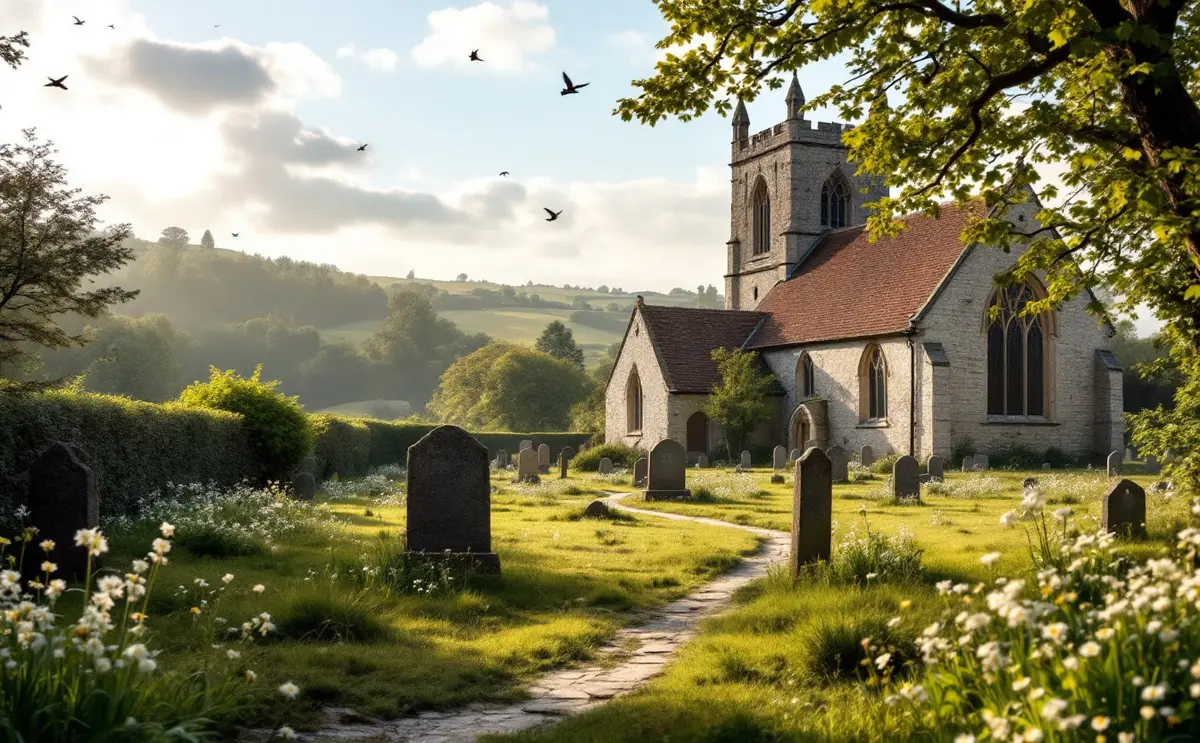
Lilley is the smallest of the three parishes this site covers, and St Peter's is the youngest of the three churches, at least to look at. Walk up Lilley Street and the church on the west side of the road looks almost entirely Victorian, all sharp flint and clean stone. Look closer and it turns out to be carrying a surprising amount of the older church inside it. And then there is the churchyard, which on a June morning can be as good a place for wild flowers and birds as anywhere in the village.
This guide covers both: the building as history, and the churchyard and lanes as places to stop, look and listen.
A church since the twelfth century, rebuilt in the 1870s
There has been a church on this site since at least the twelfth century. The Victoria County History of Hertfordshire, describing the parish in the early twentieth century, says plainly that it was wholly rebuilt in 1871. The Historic England list entry (Grade II*) gives the building dates as 1870 to 1872 and names the architect: Thomas Jekyll, working for the rector, the Rev. A. C. Haviland.
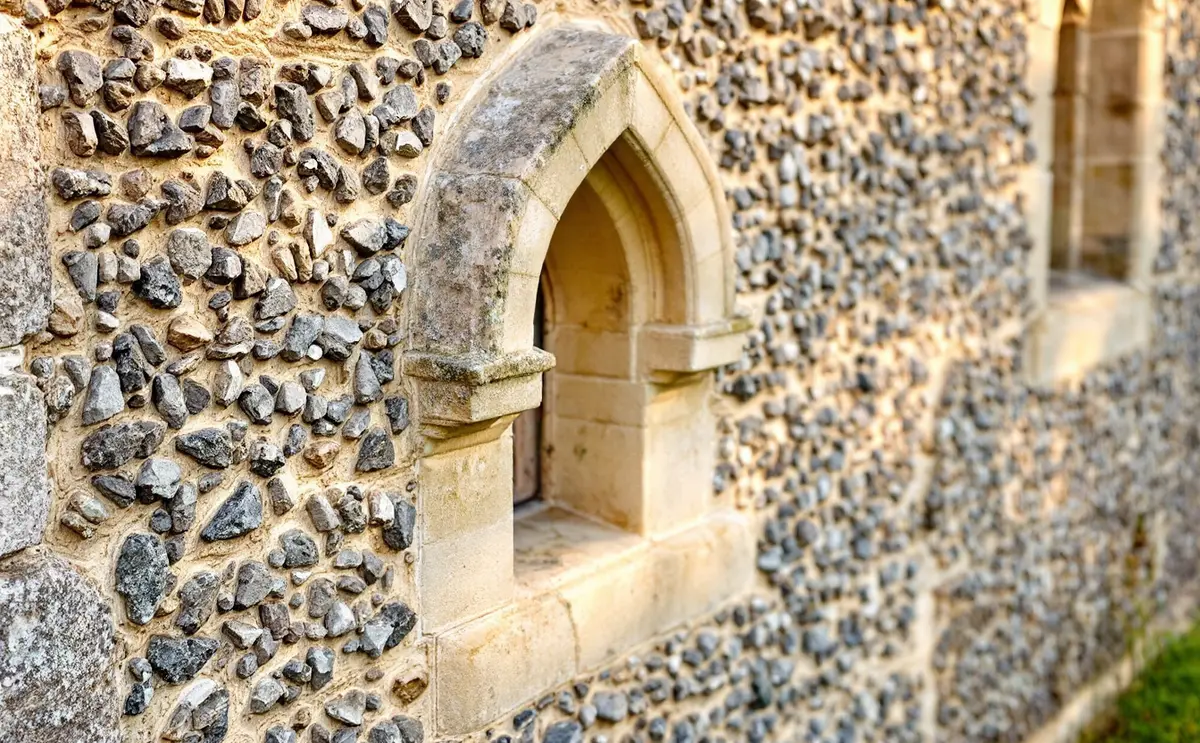
Jekyll was a Norwich architect, and Lilley is one of his less familiar buildings. His church is built of rough, uncoursed flint with smooth stone dressings, so the contrast between the dark, knobbly walls and the crisp window surrounds is part of the design. It has a chancel with a north vestry and an organ chamber, and on the south side a tall chapel for the Sowerby family, who owned the manor and lived nearby at Putteridge. The Sowerby chapel is reached by steps from the south-east corner of the nave, which gives the inside an unusual change of level.
If you are used to medieval churches, St Peter's can feel too tidy at first. Give it time. The point of visiting is to find the pieces that came through the rebuilding.
What survived from the older church
Historic England's description notes that the bells, font, piscina, monuments and a tufa arch were all brought into the new building from the old one. The parish history fills in the detail.
The tufa arch
The most remarkable survival is the old twelfth-century chancel arch, made of tufa, which Jekyll reset in the north wall of the chancel. Tufa is a porous, spongy-looking stone formed where lime-rich water deposits its minerals, and it was valued by Norman builders because it is light and easy to shape. It looks quite unlike flint or the pale freestone around it, so once you know to look for it, it is easy to pick out. This arch is the oldest thing in the church and the clearest link to the building that stood here 800 years ago.
The south doorway
Some fifteenth-century stones were reused in the south doorway. They do not announce themselves, but compare the weathering and tooling of the doorway with the Victorian stonework around it.
The piscina and font
In the chancel is a piscina, possibly fifteenth-century, with a four-centred head and an octagonal bowl and shelf, now covered in modern paint. The font is fifteenth-century too: octagonal and carved from clunch, the soft chalk building stone used across the Chilterns.
The Docwra and Houghton tablets
In the porch are two old wall tablets, one to Thomas Docwra, dated 1602, and one to Daniel Houghton, dated 1672. The Docwra name matters here. A Thomas Docwra of Temple Dinsley, near Preston, bought the manor of Lilley in 1556, and the tablet is a small reminder of that family's hold on the parish. If old memorial lettering is your thing, the companion guide to boards, brasses and inscriptions in the three churches is worth a look.
The St John's College connection
St Peter's has an unexpected link with Cambridge. The right to appoint the rector, the advowson, had passed down with the manor for centuries until 1730, when Sir George Warburton conveyed it to Lord Charles Cavendish. Cavendish sold it the following year to the Master and Fellows of St John's College, Cambridge, and the college has been patron ever since.
There is a visible trace of the link inside. The old oak pulpit, with linen-fold panels under traceried heads, was brought to Lilley from St John's College. So one of the oldest pieces of woodwork in a Victorian church in a small Hertfordshire village started life in a Cambridge college.
Three bells
The tower holds a ring of three bells, all from the old church and each from a different century. The treble is dated 1580 and may be the work of William Knight of Reading. The second was cast by George Chandler in 1703, and the tenor by T. Mears in 1821. Three bells is a small ring, which suits a small parish, and it means Lilley's bells span more than two hundred years of founding.
The churchyard as a place for wild flowers
Old churchyards can be some of the last scraps of unploughed grassland in an arable parish, and that is worth bearing in mind at Lilley, where the early twentieth-century parish history describes most of the land as arable and almost none as woodland. Where the grass is left long for part of the year, chalk-loving plants may hang on among the graves.
What to look for, depending on the month:
- In spring, cowslips and primroses in the grass, and lesser celandine in the damper shade under trees.
- In early summer, ox-eye daisies, bird's-foot trefoil and meadow buttercups, with yellow rattle where the turf is thin.
- In high summer, knapweed and lady's bedstraw, which gives off a faint smell of hay when the sun is on it.
- On old headstones and walls, lichens in grey, orange and pale green rosettes. Some take decades to grow a few centimetres, so please do not scrape them off to read a date.
A field guide to wild flowers helps with the trickier yellows, and the churchyard is a good place to practise because you can come back week after week and watch the same patch change.
Birds in the churchyard and the lanes
Churchyards are often the most tree-filled spots in an open chalk village, and birds use them accordingly. Sit on a bench or stand quietly by the wall and you may hear wrens, robins, blackbirds and song thrushes in the shrubs, with goldfinches tinkling from the tops of the trees. In summer, watch the sky over the tower for swallows and swifts.
Walk out of the village and the lanes and hedges change the cast. On the farmland around Lilley, listen for yellowhammers singing from the hedge tops in spring and summer, and look up for skylarks over the bigger fields. Buzzards and red kites are now a common sight over the Chiltern edge, the kites easy to pick out by their forked tails as they twist in the wind.
Lilley Hoo and Telegraph Hill
Two places nearby are worth knowing about if you have time for a longer walk. Lilley Hoo is a large open area of high ground east of the village, recorded in the parish history as a common. North of the village the land rises to Telegraph Hill, which the parish history puts at 602 feet, the highest point in the parish. This is chalk downland country, part of the Chilterns National Landscape (formerly an Area of Outstanding Natural Beauty), and the slopes towards Telegraph Hill and the Pegsdon Hills are where the open chalk grassland of the area is best seen.
The Icknield Way forms the northern boundary of the parish, and the Icknield Way Path, a long-distance route, passes along the edge of it. Lilley Street itself runs north-west from the Luton to Hitchin road towards that old track.
For walking, use OS Explorer 193 (Hitchin and Luton), checking the sheet edge, and follow the waymarks. Stay on the public footpaths and bridleways shown on the map; much of the land around is farmed, and some of it is private estate land. Keep dogs on leads near livestock and during the spring nesting season, when ground-nesting birds such as skylarks are easily disturbed. If you want to link Lilley with the other churches, the guides to St Mary Magdalene, Offley and St Mary's, King's Walden cover those buildings and their approaches.
Questions visitors ask about St Peter's
Is the church open?
It may well be locked. St Peter's is a parish church in use, not a visitor attraction, and there are no visiting hours to rely on. Check locally before making a special trip to see the inside. The churchyard and the outside of the building are worth the visit on their own.
Is it a medieval church?
Mostly not. The building you see dates from 1870 to 1872, but it holds older pieces: the twelfth-century tufa arch, fifteenth-century stones in the south doorway, the font, the piscina, the porch tablets and the bells.
Who designed it?
Thomas Jekyll, according to the Historic England list entry, working for the Rev. A. C. Haviland.
Are any of the graves listed?
Yes. Two monuments in the churchyard to the south of the tower are listed buildings in their own right, at Grade II. Treat them, like every grave here, with care.
Can I photograph the churchyard flowers?
Of course, but keep to the paths, avoid trampling the long grass where it has been left to grow, and be discreet if anyone is tending a grave.
Sources
This guide draws on the Victoria County History, A History of the County of Hertford, volume 3 (1912), the parish of Lilley, on British History Online; the Historic England list entry for the Church of St Peter, Lilley (list entry 1174639, Grade II*), and the separate Grade II entries for two churchyard monuments; the Corpus of Romanesque Sculpture in Britain and Ireland entry for Lilley; and Wikipedia for orientation on Lilley Hoo and the Icknield Way Path.

Bryony spends early mornings on field edges listening for skylarks and yellowhammers. She writes about farmland birds, hares, wild flowers and the life of the hedges.