Words on the walls: boards, brasses and inscriptions in three village churches
An old parish church is full of writing. Some of it is obvious, cut large on a tablet at eye level. Some is under your feet, half covered by a mat, and some hangs in a bell chamber you will never see. Most of it was put there for one of three reasons: to remember the dead, to record a gift, or to instruct the living. Once you know which of those you are looking at, the wording starts to make sense, even when it is in Latin or worn down to a ghost.
This is a guide to those texts, with examples from King's Walden, Offley and Lilley taken from the Victoria County History. Where I say a type of object is common in English churches, I do not mean these three have one.
Brasses: engraved plates in stone
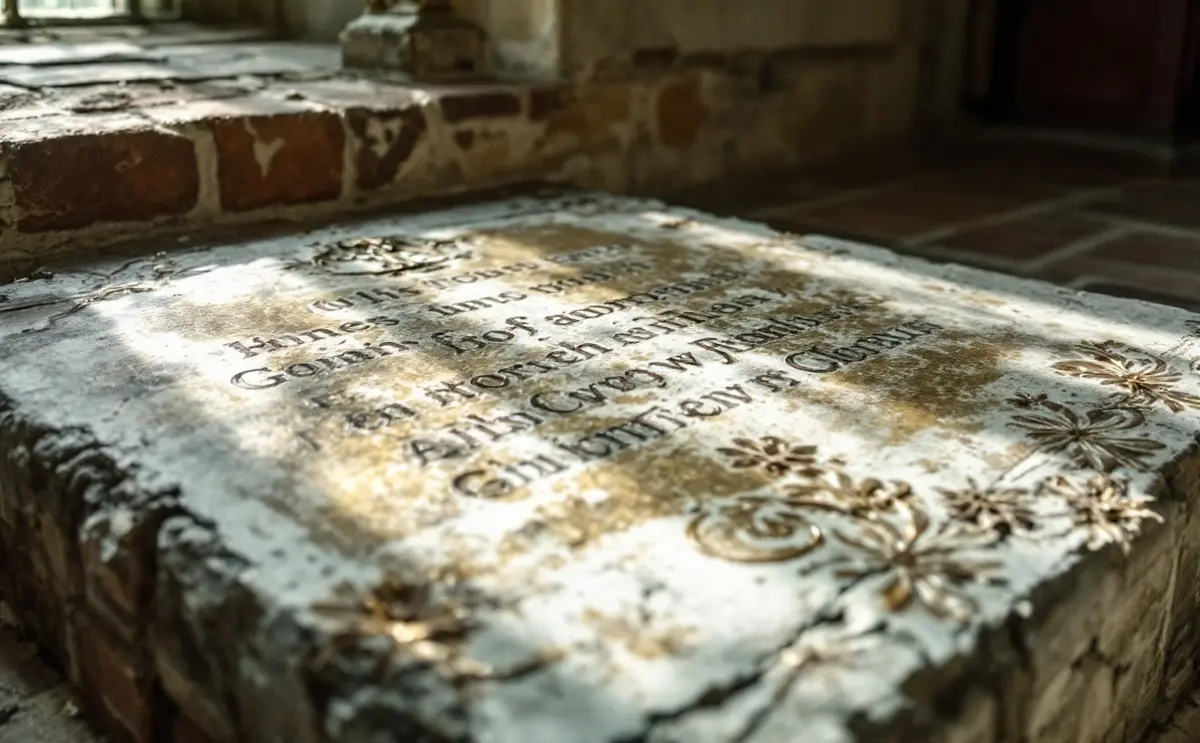
A memorial brass is a plate of latten, a hard brass alloy, engraved and set into a stone slab, usually in the floor. In England the figures and inscription plates were cut to shape and fitted into hollows chiselled to match, so the grey stone forms the background. The hollow is called an indent or matrix, and it often survives after the metal has gone. The metal was worth stealing or selling, and very many brasses were lost. Something like four thousand are thought to remain in English churches, most of them in the eastern counties.
Medieval brasses were usually in Latin, and a handful of formulas turn up again and again:
- Hic jacet means "here lies", followed by the name.
- Orate pro anima means "pray for the soul of". It asks the reader to pray for the dead person, which was a central part of late medieval belief.
- Qui obiit means "who died", followed by a day and a year, often with Anno Domini.
- Cujus anime propicietur Deus, amen means "on whose soul may God have mercy, amen", and very often closes the inscription.
Medieval engravers abbreviated heavily, with marks over letters to show missing ones, so "anime" may appear as little more than "aie" with a stroke above. After the Reformation, prayers for the dead fell out of favour, and on some brasses the orate words were scratched or cut away. By the later sixteenth century most new inscriptions were in English.
Offley has two good figure brasses. The Victoria County History describes one, on the north wall of the north aisle, showing John Samuel with his two wives and one son. A second has no inscription at all: it shows a man with his three wives and nine sons. Groups like this, children set in rows below their parents, are typical of Tudor and Stuart brasses. Without an inscription, only the costume can help date the second one. The same source notes the indents of lost brasses in two slabs on the aisle floor, which is worth knowing before you step over them.
At King's Walden the VCH records a brass of 1614 to Sybil, wife of Robert Barber, in the chancel. It is an inscription only, with no figure. Plain plates like this are easy to overlook, but they are often the earliest dated memorial in a small church.
Wall tablets and monuments
From the late sixteenth century, memorials climbed the walls. A wall tablet (also called a mural tablet) is a panel fixed to the wall, ranging from a simple slate or marble plaque to a framed composition with columns, an urn, cherubs and a coat of arms. Larger standing or wall monuments carry carved figures.
King's Walden has an alabaster wall monument of 1613 to Timothy Sheppard in the chancel, and two tablets in the north aisle to Roland Hale (1688) and Richard Hale (1689). The Hales bought the manor in 1576 and held it into the nineteenth century, so their tablets are part of the parish's history as much as its decoration. The guide to St Mary's, King's Walden explains how they fit into the building.
At Offley the VCH describes a monument of 1699 to John Spencer on the west wall of the south aisle, with elaborately sculptured figures. At Lilley, where the church was rebuilt in 1871, tablets to Thomas Docwra (1602) and Daniel Houghton (1672) were kept and now sit in the porch. The Docwras had bought the manor in 1556. Moved memorials are common in rebuilt churches, and the guide to St Peter's, Lilley covers what else survived the rebuilding.
Seventeenth and eighteenth-century tablets are usually in English. "Near this place" tells you the body lies close by rather than behind the tablet, and the virtues of the dead are listed with more confidence than modern readers expect.
Ledger stones
A ledger stone is a large inscribed slab laid in the floor over a burial, mostly of the seventeenth to nineteenth centuries. The inscription runs inside a border line round the edge or fills the centre, often with a coat of arms at the head. Because they are walked on, ledgers wear smooth, and many are hidden under pews, platforms and carpets. They are often the most neglected texts in a church.
Boards: commandments, creeds and charities
Painted boards were the cheapest way to put words on a wall, and several kinds appear in English churches.
Commandment boards carry the Ten Commandments. Orders under Elizabeth I in 1560 and 1561 required them to be set up, and Canon 82 of 1604 repeated that they should go at the east end where people could best see and read them. The Lord's Prayer and the Creed were often painted alongside, sometimes directly on the plaster. Many boards were moved to the west end or the tower in Victorian restorations, so a pair of tall boards by the font may once have stood behind the altar.
Benefaction or charity boards list gifts left to the parish: land rents, bread money, coal, apprenticeship funds. They are useful because they name donors, sums and sources, and often outlive the charity itself. The VCH records that Richard Hale, a London grocer, left by his will of 1616 a rent charge of £5 a year on Holland's Farm at Codicote, with £1 for sermons and £4 for the neediest inhabitants of King's Walden. I have not found a source that says a board recording it hangs in the church, so treat that as something to look for rather than something to expect.
Royal arms and hatchments
A painted or carved royal coat of arms became a fixture in many churches after Henry VIII broke with Rome. Arms were taken down under the Commonwealth and new ones were often painted after the Restoration, although that was not compulsory. The quarterings change with each dynasty, so a knowledgeable eye can date a set of arms from the shields alone, and many carry the monarch's initials and a date.
A hatchment is a diamond-shaped board in a black frame showing the full arms of a dead person. It developed in the early seventeenth century from the shield carried before a coffin. The hatchment usually hung on the front of the house for six months to a year and then moved to the church. The background tells you who died. If the left half (as you look at it) is black and the right white, the husband has died and the wife survives; the reverse means the wife died first. An all-black ground marks a widower or widow. A Latin motto such as Resurgam, "I shall rise again", often takes the place of the family motto. Hatchments go with manor houses, so they are worth looking for in parishes with a hall or a park.
Bells and their inscriptions
Bells are some of the oldest dated objects in a parish, and most carry an inscription cast round the shoulder: the founder's name or initials, a date, sometimes the churchwardens' names or a short motto. You will almost never see them, because towers are kept locked and bell chambers are dangerous, but the records do the reading for you.
The VCH lists the founders. Offley's six include a bell of 1583 by John Dyer, one of 1632 by Robert Oldfeild two of 1618 (one by Thomas Bartlett), one of 1619 and a tenor of 1803 by John Briant. Lilley's three run from 1580 (possibly by William Knight of Reading) through 1703 (George Chandler) to 1821 (T. Mears). King's Walden has three bells of 1627, one of 1629 and two by John Warner & Sons. A tower with bells spanning two or three centuries is normal: bells crack and are recast one at a time.
Headstones in the churchyard
Outside, the lettering changes with fashion. Early headstones, from the late seventeenth and eighteenth centuries, are often short and thick, with deep-cut lettering, and their carved tops may show skulls, hourglasses or winged heads. Later Georgian stones turn to urns and willows, and Victorian ones to marble, crosses and leaded letters. "Here lieth the body of" gives way to "In loving memory of". Good building stone is scarce on the chalk, so headstones here were usually brought in from elsewhere, and the type of stone can help with dating.
Lichen and weather make many stones hard to read. The best help is low light: early morning or late afternoon sun across the face, or a torch held flat to the surface on a dull day. Never use chalk, flour, foam or a brush; they damage the surface and feed the growths that wear it.
A quick reference
| Term | What it is | Where to look |
|---|---|---|
| Brass | Engraved latten plate set in a stone slab | Chancel and aisle floors, sometimes moved to walls |
| Indent (matrix) | The shaped hollow left when a brass is lost | Floor slabs, often under mats |
| Wall tablet | Inscribed panel or framed monument fixed to a wall | Chancel, aisles, porches of rebuilt churches |
| Ledger stone | Inscribed floor slab over a burial | Nave and chancel floors, under pews and carpets |
| Commandment board | Painted Ten Commandments, often with Creed and Lord's Prayer | East end, or moved to the west end or tower |
| Benefaction board | Painted list of gifts to the parish | Near the door, the tower arch or west wall |
| Royal arms | Painted or carved arms of the monarch | Over the chancel arch, the tower arch or a door |
| Hatchment | Diamond-shaped board of a dead person's arms | High on nave or aisle walls |
| Bell inscription | Founder, date or motto cast on a bell | Bell chamber; read the published records instead |
| Headstone | Upright churchyard memorial | South side of the churchyard first, often the oldest |
Looking respectfully
These buildings are places people still care about, and the objects in them are fragile. A few rules keep everyone happy.
- Many churches are locked outside particular times, and these three may be. Check locally before you travel; I do not give opening arrangements here because they change.
- Do not rub a brass without permission. Rubbing wears the engraving, and many churches no longer allow it at all. Photography in good light gives a better record.
- Do not lift carpets, move furniture or climb on monuments to read a line. If a ledger is covered, leave it.
- Stay off the bell ropes and tower stairs, and keep to paths in the churchyard.
The texts on the walls repay slow reading. Spring is a pleasant time to start, when the Mothering Sunday flowers are out in the churchyards and the light is low enough to bring up the lettering.

Nathaniel reads parish histories, enclosure maps and church walls with equal interest. He writes about manors, monuments, bells and what the evidence does and does not tell us.