Sloes, blackberries and good manners: hedgerow foraging on the chalk
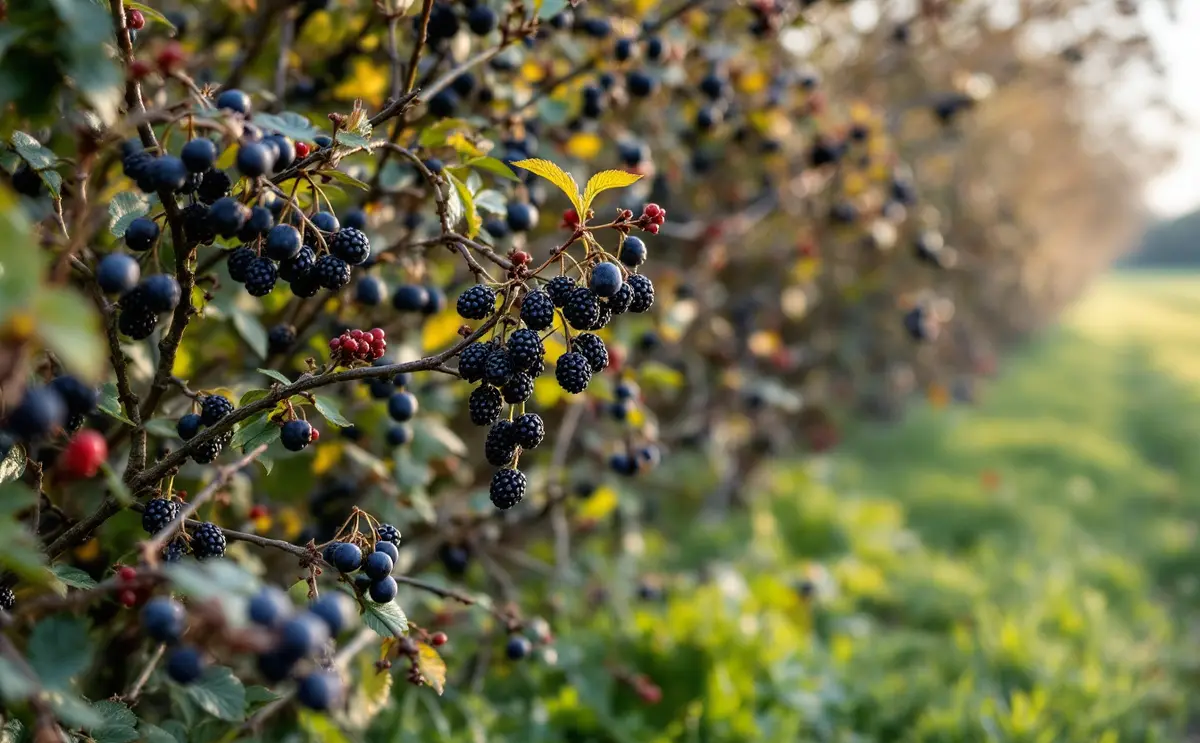
The first time I went blackberrying out here, I came back with purple hands, a scratched forearm and a carrier bag that had split at the bottom on the way home. I grew up in town, where fruit came from a shop, and it took me a couple of seasons to understand that the hedges round Offley and Lilley are not just pretty. They are a larder that runs from late July to the first hard frosts, and a habitat that a great many animals depend on through the winter.
This is a short guide to picking from them well: what to look for, what to leave alone, what the law says, and how not to be the person farmers grumble about. One rule sits above all the others.
Never eat anything you have not positively identified. If you are not sure, leave it on the bush. There will be more next year.
How the season runs
The hedges ripen in a rough order, and it is worth knowing it so you are not out looking for sloes in August.
| Fruit | When it is usually ready | What it is good for |
|---|---|---|
| Blackberries | Late July to September | Eating raw, crumbles, jam |
| Elderberries | Late August to September | Cooked only: cordial, jelly, pies |
| Hazelnuts | September | Eating fresh or roasted |
| Crab apples | September to October | Jelly, mixed with blackberries |
| Sloes | September to November | Sloe gin, jelly |
| Rosehips | September to November | Syrup, jelly (seeds removed) |
These are rough windows. A dry summer brings things on early; a cool, wet one holds them back.
The fruit, one by one
Blackberries
The bramble is the arching, prickly shrub that grows into every gap in the hedge. Fruit at the tip of each cluster ripens first and is usually the biggest and sweetest; the later ones lower down are smaller and seedier. Pick only the ones that come away easily and are black all over. Red ones are not ripe and will not ripen in the bowl.
Country folklore says you should not pick blackberries after Michaelmas, because the devil spoils them. It is folklore, but there is a grain of practical sense in it: by late autumn the berries left are often watery, mouldy or full of insects.
Elderberries
The elder is a small, untidy tree with ridged, corky bark. In late summer it carries flat, drooping heads of tiny purple-black berries on reddish stalks. They hang down; that matters for identification, as you will see below.
Elderberries must be cooked. Raw berries, and the stalks, leaves and unripe green berries, can make people ill. Strip the ripe berries off the stalks with a fork, discard any green ones, and cook them properly. They make a deep, dark cordial and a good jelly.
Sloes
Sloes are the fruit of blackthorn, the hedge shrub that flowers white on bare black branches in early spring, before its leaves. By autumn the branches carry small, round, blue-black fruits with a dusty bloom on the skin, each with a single stone. Blackthorn earns its name: the spines are long and sharp, so wear old clothes and go carefully.
A sloe straight from the bush is so sour and dry it makes your mouth pucker. The old tradition is to wait until after the first frost, which splits the skins and softens the fruit. You do not have to wait. Pick them when they are fully coloured and slightly soft, then put them in the freezer overnight. Freezing does the same job as a frost, splitting the skins so the juice can get out, and it saves you pricking each one with a pin.
Rosehips
The hips of the dog rose are bright red, smooth, oval and hard in early autumn, softening later. They are high in vitamin C, and during the Second World War people were encouraged to collect them for syrup. The inside is full of seeds wrapped in fine hairs that irritate the mouth and gut (they were once used as itching powder), so whatever you make must be strained very carefully through a fine cloth, twice if you are cautious.
Hazelnuts
Hazel grows in older hedges and copses, and the nuts sit in frilled green husks in clusters of two or three. They are ripe when the shell turns brown and the nut comes away from the husk easily. The grey squirrels usually get there first, so do not be surprised to find a hedge full of empty shells. Take a few for the pleasure of it and leave the rest.
Crab apples
Wild crab apples are small, hard and very sour. They are no good for eating raw, but they are rich in pectin, which makes them excellent for jelly on their own or mixed with blackberries to help a jam set.
The ones to leave alone
This is the section to read twice. Several common plants on chalk hedges and woodland edges carry berries that look tempting and are poisonous, some seriously so. A good field guide with clear pictures is worth taking with you, and if you have any doubt at all, leave it.
Black berries
- Deadly nightshade: A bushy plant with large leaves, dull purple bell-shaped flowers and single shiny black berries, each sitting in a green star of leafy sepals. It is very poisonous. It is not common, but it does grow on chalk and limestone, at woodland edges and in disturbed ground.
- Purging buckthorn: A shrub of chalk scrub and hedges with clusters of black berries close to the branches. They are a strong purgative. Sloes, by contrast, are single, larger and dusty blue, on spiny branches, each with a single stone.
- Privet and dogwood: Both carry black berries in hedges. Privet berries are poisonous; dogwood berries are inedible and bitter. Neither hangs in drooping, flat heads like elder.
Red berries
- White bryony: A climber that scrambles over hedges using curly tendrils, with lobed, ivy-like leaves and strings of red berries in autumn. All parts are poisonous.
- Black bryony: Another climber, with glossy heart-shaped leaves and long strings of shiny red berries. Also poisonous.
- Woody nightshade (bittersweet): A scrambling plant with purple and yellow flowers in summer and oval red berries. Poisonous.
- Honeysuckle: The berries are red, glossy and in small clusters. They are considered mildly poisonous and are best left for the birds.
- Lords-and-ladies: A spike of orange-red berries standing up from the ground at the hedge bottom in late summer. Poisonous, and it irritates the mouth badly.
- Yew: The red, fleshy cup round the seed looks harmless, but the seed inside and the foliage are highly poisonous.
- Spindle: A hedge shrub that is lovely in autumn, with pink, four-lobed fruits that split to show bright orange seeds. Poisonous.
A rosehip is smooth, firm, oval and borne singly or in small groups on a thorny rose stem. If what you are looking at is on a climber, in a string, on a spike, or does not match every one of those features, it is not a rosehip.
The law, briefly
In England, the Theft Act 1968 says that picking wild fruit, flowers, foliage or mushrooms growing wild on any land is not theft, as long as you are not doing it for reward, for sale or for some other commercial purpose. So a bag of blackberries for your own crumble is fine.
That rule does not give you a right to go anywhere you like. Stay on public rights of way, which in this part of Hertfordshire are shown on the definitive map kept by the county council and on the OS Explorer map. Do not climb into fields, push through hedges or cross land you have no right to be on to reach the fruit. Uprooting a wild plant without the landowner's permission is an offence under the Wildlife and Countryside Act 1981, so pick fruit, never whole plants. Fruit in gardens, orchards and cultivated plots is not wild and is not yours to take.
Etiquette, which matters as much as law
- Leave plenty for wildlife: Hedge fruit feeds thrushes, blackbirds, the winter flocks of fieldfares and redwings, small mammals and insects. There is more on the birds that rely on these hedges in the piece on farmland birds between Offley and Lilley. Take a little from each bush and move on.
- Avoid sprayed field edges: Fruit hanging over a crop may have caught spray drift. If the field edge looks freshly treated, pick elsewhere.
- Avoid busy roads: Roadside hedges catch exhaust and dust. The lanes and tracks away from traffic are better.
- Do not break branches: Pull a bramble towards you gently, never snap a blackthorn bough to reach the top. Next season's fruit depends on the wood you leave.
- Leave gates as you find them and keep to the path: The Countryside Code applies to foragers like everyone else.
Why the hedges are here at all
It helps to know what you are picking from. Many of the hedges round these villages are the product of parliamentary enclosure, when the old open fields and commons were divided into the rectangular fields you see today. Lilley was enclosed under an Act of 1768, King's Walden under an Act of 1796 to 1797 with the award in 1802, and Offley under a private Act of 1807. The new boundaries were mostly planted with hawthorn, often called quickthorn, and they tend to run straight and have fewer kinds of shrub in them.
Older hedges are different. Along ancient lanes and parish boundaries, such as the line of the Icknield Way, which forms the northern boundary of both Lilley and Offley, you often find curving hedges on banks, with a ditch alongside and a greater mix of species: hazel, field maple, dogwood, spindle and old pollards. Naturalists sometimes use a rough rule that counts woody species in a set length of hedge to estimate its age, but it is only a rough guide and local history often gives a better answer. You can see the contrast on the walk from Lilley up the Icknield Way to Telegraph Hill, or on the Offley circular walk.
The practical point for a forager is that older, mixed hedges usually offer more variety, and they can also hold more of the poisonous plants listed above. More choice means more care.
A simple sloe gin
This is an outline rather than a precise recipe, because everyone has their own proportions and argues about them.
- Pick sound, ripe sloes, discarding any that are split or mouldy. Remove leaves and stalks and rinse.
- Freeze them overnight to split the skins, or wait for a frost before picking.
- Fill a clean, sterilised jar about half full with sloes.
- Add sugar: a modest amount to start, perhaps a few tablespoons for a large jar. You can sweeten more later, but you cannot take it out.
- Top up with gin, seal the jar and shake it well.
- Keep it somewhere cool and dark, and shake it every few days for the first couple of weeks, then occasionally.
- After two or three months, strain through muslin into clean bottles. Taste and add a little sugar syrup if it needs it.
It improves with keeping, and a bottle started in October is traditionally ready for Christmas. Please drink it in moderation, and never drive after.
Before you go out
Take a shallow tub rather than a bag (I learned that one the hard way), wear long sleeves, and carry a field guide. Above all, remember the rule from the top: if you cannot name it with certainty, do not eat it.

Sunil came to the villages from a nearby town and has been asking questions about them ever since. He writes about country customs, hedgerow food and family days out.