Your first season on a flinty chalk allotment
The letter offering you a plot often arrives in autumn. That is a good time to start: it gives you a whole winter to clear ground, think, and make the mistakes that cost nothing.
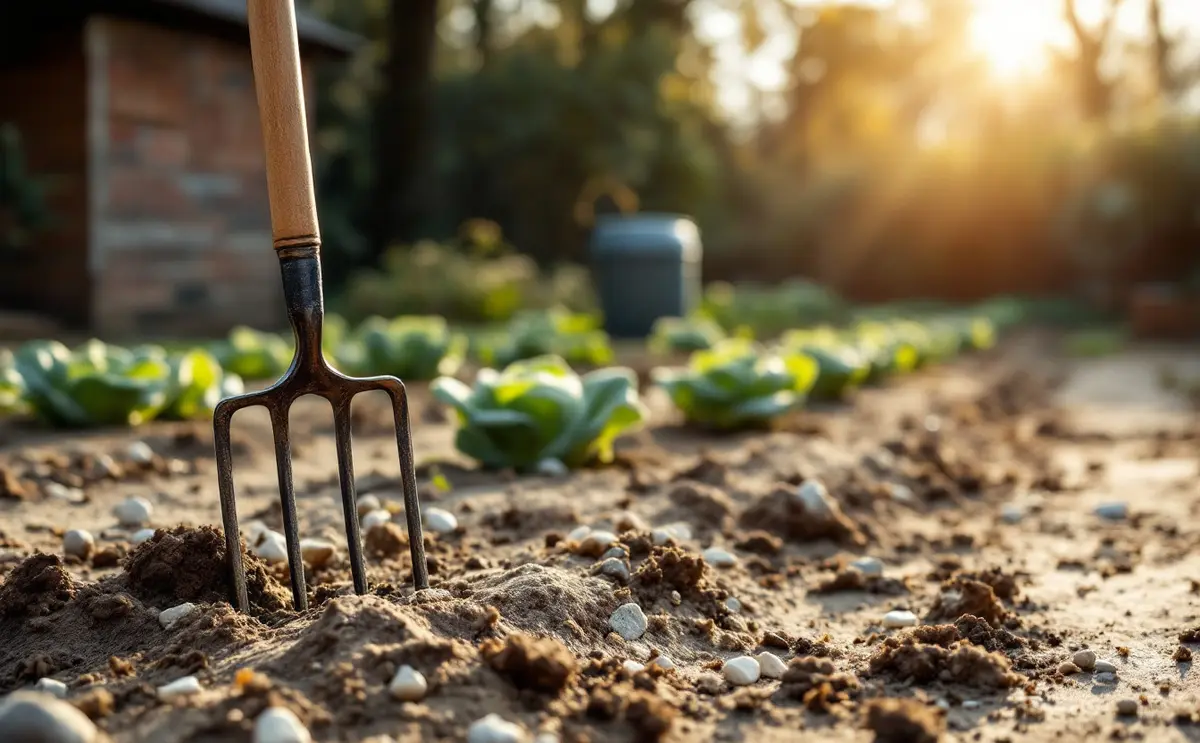
On the chalk round King's Walden, Offley and Lilley, a new plot comes with its own character. The soil is pale, quick to drain, quick to warm in spring and quick to dry in July. And it is full of flints. Every spadeful turns up a few, white-skinned and glassy grey inside. Nobody I know has ever finished picking them out.
Here is the order I would work in if I started again.
Before you touch a weed
Read the tenancy agreement and the site rules. The National Allotment Society's advice to new plot holders starts here, because sites differ on sheds, fruit trees, bonfires and hosepipes. Some councils set a probation period for new tenants, and most agreements expect the plot to be kept cultivated and reasonably free of weeds.
Then walk the plot slowly. Weeds tell you things. Couch grass and bindweed mean deep roots and patience. Brambles mean nobody has been near that end for a while, and there may be old glass or wire under them.
Look at the neighbours' plots too. The best soil test is often the row of leeks next door.
Clearing in stages, not in a weekend
The National Allotment Society advises working a section at a time and covering the rest, and some council guides warn that an overgrown plot can take the best part of a year to clear. On chalk:
- Cut everything down to near ground level so you can see the shape of the plot.
- Pick one bed's worth of ground, perhaps a quarter of the plot, and dig it properly, lifting out every bit of perennial root you can find.
- Cover the rest with a light-excluding weed membrane, weighted down at the edges. Council allotment guides suggest proper weed matting rather than old carpet, which breaks down into the soil.
- Come back to the covered ground in late winter, when much of the top growth underneath will have died back.
Rotavating a plot full of couch or bindweed chops the roots into hundreds of pieces and plants each one. The Society's tips warn against it unless the ground is free of perennial weed roots, and on a new plot it almost never is.
Perennial weed roots should not go straight on the compost heap. They can be killed by sealing them in a black bag for a year or drowning them in a lidded tub of water, and anything that has set seed is better taken to the council's green waste than spread round your own ground.
Living with flints
The big flints are worth lifting out as you dig, and they make good path edging. But every winter's frost seems to bring up a fresh crop. Take out what gets in the way of a hoe or a carrot, and leave the rest.
Small stones help a light soil drain. Carrots and parsnips are the crops that mind them most, forking when the root hits a stone. A raised bed or two filled with sieved soil and compost, or simply growing shorter, stump-rooted carrots, gets round the problem.
Feeding a hungry soil
The RHS describes chalky soils as alkaline (pH above 7), often shallow and stony, free-draining and dry in summer. It also points out that organic matter breaks down quickly in them, so fertility is hard to hold on to. That is the whole story of chalk gardening in a sentence: you add muck, and the soil eats it.
So add it every year: well-rotted manure, garden compost, leaf mould, dug into new beds and spread as a mulch. The RHS suggests a mulch of at least 5cm in late autumn to late winter, roughly November to February, to hold moisture and feed the soil. On a flinty plot, mulching on top is kinder to your back than digging in, and the worms do the rest.
Green manures help too: the RHS mentions crimson clover and vetches for chalk, which fix nitrogen and cover bare ground.
The RHS adds that iron and manganese can be locked up in alkaline soil, showing as yellowing between leaf veins, and that light chalky soils often need fertiliser as well. Making chalk acid with sulphur is impractical.
Brassicas: the chalk plot's best crop
The good news: cabbages, sprouts, kale, purple sprouting broccoli and swedes like firm, settled ground, and chalk suits them.
Clubroot, the disease that swells and distorts brassica roots and ruins whole beds, is less of a problem here. The RHS notes that clubroot is less prevalent in alkaline soil and that brassicas on chalky ground are less likely to get it. Less likely is not never, though. The RHS also says the resting spores can stay in soil for up to twenty years, which is why you should be wary of brassica seedlings of unknown origin and of soil on boots and tools from another plot. Raise your own plants from seed if you can, and keep swollen-rooted plants off the compost heap.
The real enemies of brassicas on an open hilltop plot are pigeons and caterpillars. Fine mesh netting on hoops, held well clear of the leaves, deals with both.
Potatoes and the scab question
The flip side of alkaline soil is common scab on potatoes, rough corky patches on the skin that look poor but are mostly skin deep. The RHS says scab is especially common on alkaline soils and worse when the soil is dry as the tubers form. Its advice is to keep the soil from drying out while the tubers develop, add organic matter, and choose varieties with some resistance. It also says lime should go on after the potato part of a rotation, not before, which on chalk usually means you will not need lime at all.
What thrives with little fuss
On a well-fed chalk plot, the easiest things in my experience are:
- broad beans, sown in autumn or early spring
- all the brassicas, netted
- beetroot, chard and spinach beet
- onions, shallots and garlic, which like the drainage
- leeks, planted deep in early summer
- runner and French beans, if you can water them in a dry spell
- herbs from dry hillsides: thyme, sage, marjoram, rosemary
- rhubarb, given plenty of muck
Salads bolt in a hot dry spell, so sow little and often. For the flower border at home, our earlier piece on chalk garden plants for thin, dry soil goes through the ornamentals.
Water on a free-draining hill
Chalk plots dry out, and many sites restrict hosepipes, so you will carry cans. A good soak to the roots once or twice a week in a dry spell beats a nightly splash that wets the top centimetre and is gone by breakfast. Water in the evening or early morning, mulch straight after, and group thirsty crops together so you are not walking the length of the plot for one courgette.
Collect rain off any shed or greenhouse roof into water butts. Fit lids, both to keep out leaves and to stop mosquitoes breeding.
The first year, month by month
This assumes you take on the plot in early autumn. Adjust to your own start.
| Month | Main jobs on a chalk plot |
|---|---|
| October | Read the rules, cut down, clear the first bed, cover the rest, sow broad beans if the ground is ready |
| November | Plant garlic, spread manure or compost as a mulch on cleared beds, lift big flints as you dig |
| December | Plan beds and a simple rotation, order seed, mend or build a compost bay |
| January | Check covers, dig further sections on dry days, set up water butts |
| February | Chit seed potatoes, spread more mulch, sow early broad beans and onions under cover at home |
| March | Plant onion sets and shallots, sow early peas, prepare the brassica bed firmly |
| April | Plant potatoes, sow beetroot, chard and carrots, raise brassica seedlings in pots or a seedbed |
| May | Plant out brassicas under netting, sow runner and French beans after the last frost risk |
| June | Plant leeks, water deeply in dry spells, mulch everything you can |
| July | Harvest early potatoes and broad beans, keep beans watered, watch for caterpillars |
| August | Sow a green manure on any bare bed, save rain, pick beans often |
| September | Harvest maincrops, sow spring cabbage, start clearing the next section |
Kit for flinty ground
On chalk with flints the wrong tool is hard work. No makes are named here and nothing has been tested for this piece: this is about types.
Fork or spade
On stony ground a garden fork is usually the easier tool for breaking ground. The tines slide past flints that would stop a spade blade dead and jar your wrists. Use the fork for the first dig and for lifting potatoes and leeks. Keep a spade for cutting straight edges, digging trenches and moving loose soil. Whichever you buy, look for a strong socket where the head meets the shaft, as flints test that joint harder than anything.
Hand tools
A sturdy hand trowel and hand fork, again with a solid joint at the neck, cover most planting. A draw hoe and a Dutch hoe keep weeds down between rows, and a hoe used often on dry chalk does more weeding than any other tool.
A digging knife
A hori hori style knife is worth having on stony ground. It is a broad, slightly dished steel blade, usually with one serrated edge and depth markings, on a short handle. It plants bulbs, prises out dandelion roots, cuts twine and levers up the flint wedged under your onion set.
Knees and back
A foam kneeler makes a real difference on stony soil. Some come on a frame with side handles that help you get up again.
Water
One or two water butts with lids and taps, raised on blocks so a can fits underneath, and a pair of cans of a size you can carry full. A rose that unscrews lets you soak seedlings gently and pour straight to the roots of bigger plants.
You can find more on outdoor kit and books on the rucksack page. And when the beans are in and the brassica nets are up, the hedgerows round the plot have their own harvest, covered in our guide to picking sloes and blackberries considerately.
The first year on a chalk plot is mostly about the soil. Feed it, cover it, water it deeply, and by the second autumn the bed you cleared first will be darker and easier to work than anything else on the site.

Alice gardens on thin, flinty chalk and keeps an allotment that teaches her something new each season. She writes about cottage plants, vegetables and gardening with birds in mind.