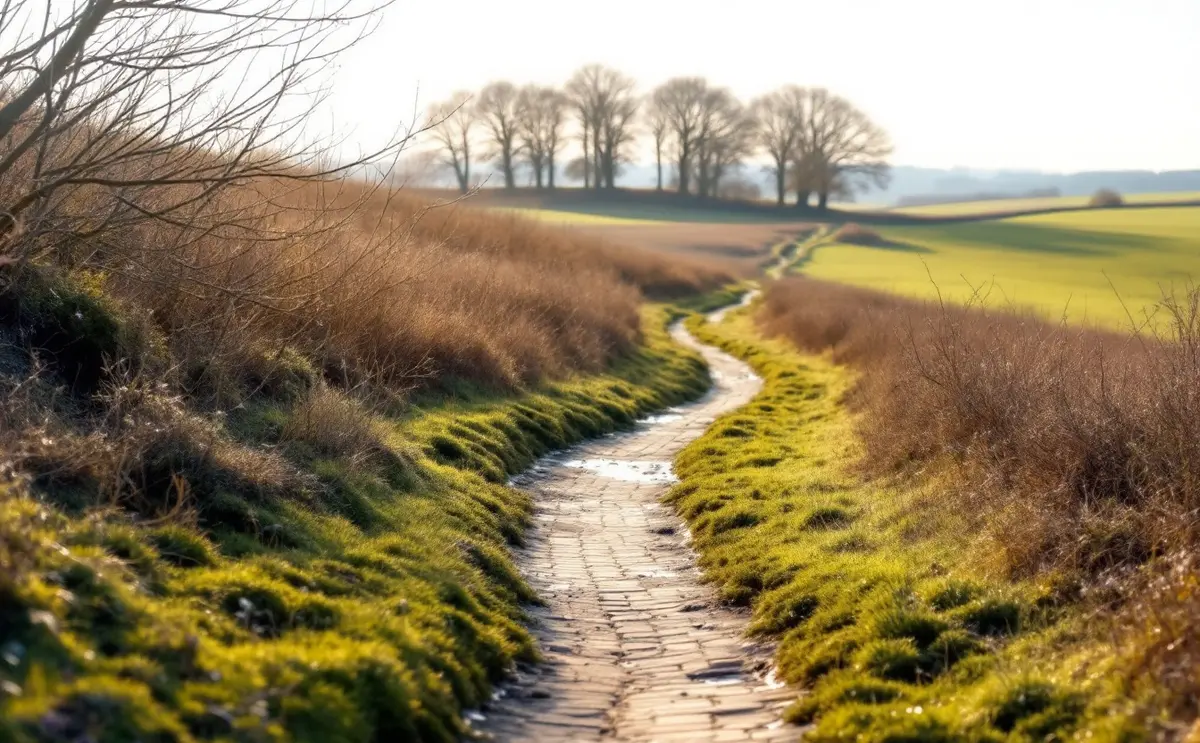
Hertfordshire footpaths in the muddy months: ploughed paths, obstructions and mud
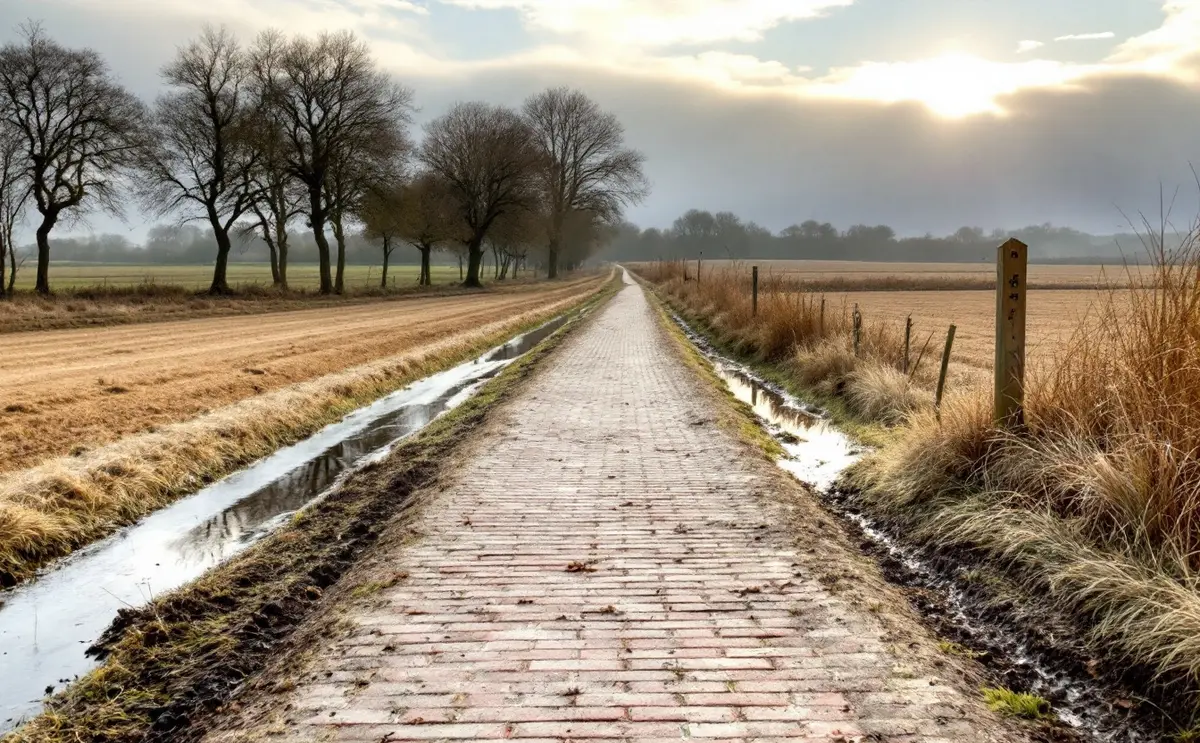
There is a particular moment on a November walk when you climb a stile, look out over a field that was golden stubble a month ago, and find it ploughed from hedge to hedge with no sign of the path at all. The map says the footpath goes straight across. The field says otherwise. Your boots, already carrying a kilo of the last field, would rather go round.
This piece is about that moment and the rest of the muddy half of the year: what the law says about ploughed and cropped paths, what counts as an obstruction, how to report a problem to Hertfordshire County Council, and how to walk on chalk and clay without ending up on your back.
The rules on ploughing, in brief
Farmers are allowed to plough some public paths. That surprises people, but it is long-standing law, and on arable land like the fields round Lilley and Offley you will meet it every autumn. What matters is which kind of path, and what happens afterwards.
Hertfordshire County Council's own guidance to landowners sets it out plainly:
- A cross-field footpath or bridleway may be ploughed if it cannot reasonably be avoided.
- Once ploughed, it must be reinstated and clearly marked within 14 days.
- After any later disturbance, such as drilling or rolling, it must be put right within 24 hours.
- A path that runs along a field edge must not be ploughed at all.
- Byways and restricted byways must never be ploughed.
- The landowner must keep the minimum width clear, with nothing overhanging, and the surface reasonably level and firm.
"Reinstated" means the path is made walkable again and its line is visible on the ground, usually by rolling or treading a strip through the plough. The legal minimum widths that county councils publish for paths that are ploughed or cropped are these (a path's own legal record can set a different width, so treat these as the default):
| Type of path | Cross-field | Field-edge |
|---|---|---|
| Footpath | 1 metre | 1.5 metres |
| Bridleway | 2 metres | 3 metres |
The rule on crops is separate and runs through the whole growing season. The occupier must stop a crop growing on or over the path. A footpath through a field of winter wheat should be a clear line of bare or trodden ground at least a metre wide, not a faint dip in the crop that you can only find by walking into it.
So what do you actually do?
If the 14 days are not up, the farmer is within the rules and you are walking on fresh plough. Walk the line of the path anyway. That is what the Countryside Code asks, and it is your right. Going round the headland may feel kinder to the crop, but on a cross-field path it is not the right of way, and a well-trodden detour can become an argument later about where the path really runs.
If the path has clearly been ploughed or planted for weeks and not reinstated, the Ramblers' advice is that you may still walk its line through the crop, or go round the field edge if that is a sensible alternative. Taking a compass bearing from the stile to the far waymark is the cleanest way to keep a straight line across a featureless field; the piece on reading an OS Explorer map on the Chiltern edge shows how.
Then report it. A single walker's report is how most of these problems get fixed.
Obstructions
Ploughing is a specific, temporary thing. An obstruction is anything that physically stops you using the path: a locked gate, a new fence across the line, a padlocked stile, a pile of manure or bales dumped on the route, a hedge allowed to grow solid, electric fencing without a way through. Obstructing a public highway is an offence, and the council has a duty to keep rights of way open.
Local walking groups advise that you may remove enough of an obstruction to get past, if you can do it without damage, and that if keeping to the line would be dangerous you should take a short, sensible way round, using another public path where possible. In practice I would never cut a fence or force a gate. Climb if it is safe, go round if it is not, take a photograph and report it.
There are things that look like obstructions but are not. A gate that is closed but opens is just a gate. A field with cattle in it is not obstructed. And a new gate where a stile used to be may well have been put up with the council's permission.
Reporting a problem to the county council
Hertfordshire County Council keeps the definitive map, the legal record of every public right of way in the county, and it handles problems on them. Its rights of way pages link to an online form for reporting a fault. A useful report contains:
- Where. A grid reference from your map or phone is far better than "the field after the big oak". Say which villages the path links if you are not sure of its number.
- What. Ploughed and not reinstated, cropped over, gate locked, stile broken, waymark missing, path flooded.
- When you saw it. Dates matter for the 14-day rule.
- A photograph or two, taken from the path, showing the problem and enough of the surroundings to recognise the spot.
- Whether it stopped you, or just slowed you down.
Be factual and polite, and do not guess at who is responsible. The council will work that out.
Livestock in winter
Many cattle are brought indoors for the winter, but not all, and sheep are often out on grass and stubbles. A few points are worth carrying in your head:
- Bulls. Under the Wildlife and Countryside Act 1981 it is an offence for the occupier to let a bull of a recognised dairy breed loose in a field crossed by a public right of way, unless it is ten months old or younger. Bulls of other breeds over that age are allowed only if cows or heifers are in the field with them. That does not make a beef bull among cows safe to approach; give the whole group a wide berth.
- Cows with calves are the real hazard on footpaths, at any time of year. Walk calmly, do not get between a cow and her calf, and keep moving.
- Dogs. The Countryside Code says it is good practice to keep your dog on a lead around livestock, and that if cattle or horses chase you, let the dog go. It will outrun them; you will not.
- Gates. Leave them as you find them. A gate propped open in a field of sheep is usually open for a reason.
Walking in mud, properly
Now the practical part. Round these villages you meet two quite different muds.
Chalk paste
On the slopes and the lower fields, wet chalk turns into a pale, greasy paste. It is shallow, rarely deep enough to swallow a boot, but it is slippery in a way that catches people out on even a gentle descent. Downhill, shorten your stride, keep your weight over your feet rather than leaning back, and put each foot down flat. Grassy edges are often worse than the mud itself, because the grass lies flat over the paste like a wet carpet.
Clay with flints
On the higher, flatter ground, the chalk is often capped with heavy clay full of flints. This is the sticky stuff. It builds up on the soles until your boots are twice their size and grip nothing. Stop and kick it off against a gatepost or a stone every few hundred metres rather than carrying it, and choose boots with a sole pattern that sheds mud, with deep, widely spaced lugs.
Habits that help
- Walk through the middle of a muddy path, not round its edges. Skirting every puddle widens the path into the crop or the hedge bank, and in a few winters a one-metre path becomes a five-metre scar.
- Use poles on slopes and greasy stretches. A pair of plain aluminium trekking poles gives two extra points of contact, and a short length is better than a long one for going downhill.
- Gaiters keep the worst out of the top of your boots and the bottom of your trousers.
- Allow more time. Mud adds a surprising amount to a walk, and a route that takes two hours in June can take three in December. The walk timer gives a Naismith estimate; add a generous margin for the conditions.
- Watch the light. By mid-December it is getting dark before four o'clock in the afternoon. Plan to be off the field paths and onto a lane well before then.
Questions walkers ask in winter
Can I walk round the edge of a ploughed field instead?
On a cross-field path the right of way is the line across the field, not the edge. If the path has not been reinstated and the edge is a practical alternative, walking it is a reasonable choice, but report the problem so it is put right.
The path is flooded. Is that an obstruction?
Sometimes, if it is persistent and makes the route impassable. Report it with a photograph. The council may need to deal with drainage, or the landowner with a blocked ditch.
Is the farmer breaking the law if I find a ploughed path?
Not if it is within 14 days of ploughing, or within 24 hours of a later operation, and the path is a cross-field one. A ploughed field-edge path, or any path left unreinstated well beyond those periods, is a different matter.
Where can I find a good winter route?
Lanes and bridleways with firm surfaces are kinder in December than cross-field paths. The Offley circular walk includes a section on mud by month that will help you pick your season.

Hugh walks the footpaths and bridleways of the Chiltern edge with a paper map in a plastic sleeve. He writes about routes, stiles, mud and the kit that earns its place in a daypack.