Water on dry hills: dew ponds, skylarks and the idea of an inland wave
Stand on the open chalk above Lilley on a still May morning and the loudest thing is the skylark. The next thing you notice is how little open water there is, because rain sinks into chalk almost as soon as it lands. Water away from the sea fascinates me, and when someone types surf wave pool Florida into a search box they are after a stranger version of it: a breaking wave well inland, far from any beach.
Most of this piece is about water on dry ground and the wildlife it draws in, because that is what I spend my early mornings listening for. It ends with a detour to a very different kind of inland water, for families planning a holiday a long way from Hertfordshire. Keep your ears open on the way.
Why the chalk hills run short of water
Chalk is porous. Rain falls on the fields, soaks down through the thin soil and into the rock, and travels underground until it meets something it cannot pass through. Where that happens, at the foot of a slope, it comes out again as a spring. Many chalk villages grew up close to such springs for the obvious reason, and the high ground between them was left to sheep, arable fields and the birds.
So the tops are dry in a way that surprises visitors. There are few streams, few ponds and, in a hot summer, very little standing water at all. The ditches that run full in February are dust by August. For birds and animals that live up there, a reliable drink can be the most valuable thing for miles, and they will travel a surprising distance to reach one.
You can see the effect if you know where to look. After a dry spell, the busiest place on a farm is often a cattle trough or a leaking tap in a yard, with sparrows, finches and pigeons queuing along the edge.
Dew ponds and the old troughs
The old answer to dry hilltops was the dew pond: a shallow hollow lined to hold rainwater, made so that livestock grazing the high ground had something to drink. The name suggests they filled with dew, and there is plenty of lore about how they were built and how they worked. Accounts vary, and I would treat the more romantic versions with care. What is clear is that a well-made pond on high chalk held water when little else did.
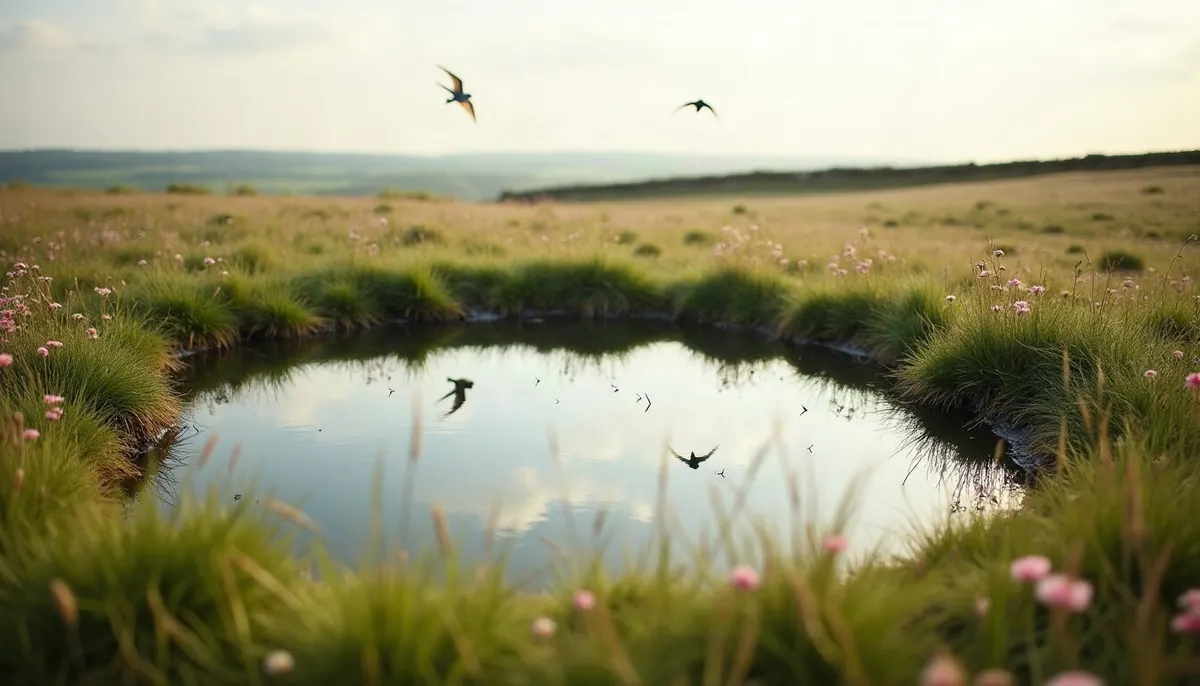
Where such ponds survive and still hold water, they become small oases. Swallows and house martins skim the surface for insects on summer evenings. Dragonflies patrol the margins. Birds come down to drink and bathe, and frogs and newts may turn up where the water stays all year. A pond the size of a large room can bring more life to a dry hilltop than a whole field of crops.
The same is true, on a smaller scale, of a garden pond, a bird bath or a shallow dish kept topped up. On chalk, water you put out in a dry summer will be found, and quickly.
If you add water to a garden, a few small choices make it more useful. A shallow, sloping edge lets birds stand and drink without wading in too deep, and a stone or a stick gives anything that falls in a way out. Clean water matters more than a large volume, so a dish refilled every day does more good than a big container left to turn green. Put it within a short flight of a hedge or shrub, so birds can come and go without crossing open ground in full view of the neighbourhood cat.
What to look and listen for at water in a dry summer
If you want to see what water does for wildlife on dry ground, sit near it quietly for half an hour early or late in the day. A few things to watch for:
- swallows and martins dropping low over the surface, sometimes touching it to drink in flight
- wagtails walking the edge, tails pumping, picking insects off the mud
- finches and sparrows arriving in small groups to drink and bathe
- dragonflies holding a short beat along one margin and chasing off rivals
- the evening chorus moving closer as birds come in for a last drink
Bring a flask and leave the phone in your pocket. The birds are wary at water, because a drinking bird is an exposed bird, and they notice movement long before they notice you.
Notebook margin: On the chalk, water tells you where life gathers. A wet patch in a field corner, a leaking trough or a pond on a hilltop will draw birds from a wide area in a dry spell, and on ground where rain disappears so fast, any standing water becomes a meeting place.
Inland water on holiday
All of which brings me to the odder question of inland waves. Families who live a long way from the sea, or who want somewhere predictable to learn, sometimes look for a surf park: a large pool where waves are made by machine rather than by weather. Florida has a surf park at Fellsmere, away from the coast, and for a family planning a trip there it can be a different sort of day out from the beach.
I can only offer general thoughts, because I have never surfed and would not pretend otherwise. A made wave is predictable, which is one reason people choose such places to learn. The rest is common sense for any water day with children:
Before you go
- Check the park's own pages for what it offers, any age or swimming requirements and how sessions are booked.
- Be honest about how well each member of the family swims.
- Plan for the sun. Florida is hot and humid, and long hours in and around water need shade, water to drink and sun protection.
- Expect to be tired. Learning to stand on a board is hard work, and so is watching from the side in the heat.
There is wildlife in the picture too. Florida is famous for its water birds, and herons and egrets are a common sight wherever there is water. A family with binoculars in the bag may find that the walk from the car is as interesting as the waves, which is no bad thing for the ones who are waiting their turn.
What strikes me, thinking about it from a dry hill in Hertfordshire, is how much people value water they can rely on. The sheep on the old downs needed a pond that held through August. A child learning to surf needs a wave that turns up when the lesson starts. In both cases someone has built the water where nature did not quite provide it.
The year on the chalk
- Winter: break the ice on the bird bath each frosty morning and keep it topped up.
- Spring: scrub the bird bath and refill it before the first warm, dry spell.
- Summer: set out a shallow dish of fresh water and watch who comes to it at dusk.
- Autumn: clear fallen leaves from the garden pond so the water stays clean through winter.
Whether it is a dew pond on a hilltop or a wave in a pool far from the sea, water in an unlikely place always draws a crowd, and I never tire of watching who turns up.

Bryony spends early mornings on field edges listening for skylarks and yellowhammers. She writes about farmland birds, hares, wild flowers and the life of the hedges.